
Subaru Legacy BN/BS (2015-2019) Owners Manual: GVWR and GAWR (Gross Vehicle Weight Rating and Gross Axle Weight Rating)
The certification label attached to the driver's side door shows GVWR (Gross Vehicle Weight Rating) and GAWR (Gross Axle Weight Rating). The GVW (Gross Vehicle Weight) must never exceed the GVWR. GVW is the combined total of weight of the vehicle, fuel, driver, all passengers, luggage, any optional equipment and trailer tongue load. Therefore, the GVW changes depending on the situation. In addition, the total weight applied to each axle (GAW) must never exceed the GAWR. The front and rear GAWs can be adjusted by relocating luggage inside the vehicle. Even if the total weight of your luggage is lower than the vehicle capacity weight, either front or rear GAW may exceed the GAWR, depending on the distribution of the luggage. When possible, the load should be evenly distributed throughout the vehicle. If you carry heavy loads in the vehicle, you should confirm that GVW and front and rear GAWs are within the GVWR and GAWR by putting your vehicle on a vehicle scale, found at a commercial weighing station. Do not use replacement tires with a lower load range than the originals because they may lower the GVWR and GAWR limitations. Replacement tires with a higher load range than the originals do not increase the GVWR and GAWR limitations. |
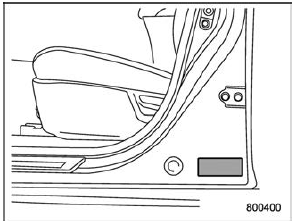
 Vehicle capacity weight
The load capacity of your vehicle is
determined by weight, not by available
cargo space. The maximum load you can
carry in your vehicle is shown on the
vehicle placard attached to the driver's ...
 Roof rack (Outback - if equipped)
CAUTION
For cargo carrying purposes, the
roof rail must be used together
with the roof rack. The roof rail
must never be used alone to
carry cargo. Otherwise, dama ...
Other materials:
Dtc u0169 lost communication with sunroof control module
DTC DETECTING CONDITION:No data is received from sunroof unit.TROUBLE SYMPTOM:The sunroof does not operate normally.WIRING DIAGRAM:NOTE:For the coupling connector, refer to “WIRING SYSTEM”.Sunroof Control System Sunroof Control System > WIRING DIAGRAMSTEPCHECKYESNO1.CHECK DTC.Read the D ...
