
Subaru Legacy BN/BS (2015-2019) Service Manual: Inspection
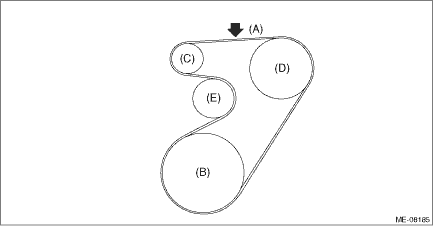
CAUTION: Check and adjust the V-belt tension so that it is within the specified range. Using the belt with a tension out of the specified range may result in a fault such as the following: • If the V-belt tension is higher, unexpected force is generated at the power steering oil pump, generator and crankshaft bearing, causing abnormal noise due to abnormal wear of the bearing. • If tension of the V-belt is too low, slipping of the V-belt and crank pulley occurs and crank pulley becomes abnormally hot by friction heat. If this condition repeatedly occurs, the V-belt may abnormally wear, causing abnormal noise, V-belt damage or crank pulley damage. 1. Replace the V-belt, if cracks, fraying or wear is found. 2. Inspect the V-belt tension, and adjust if necessary. V-belt tension (with sonic belt tension gauge): When installing new parts 1080 — 1230 N (110 — 125 kgf, 243 — 277 lbf) At inspection 570 — 720 N (58 — 73 kgf, 128 — 162 lbf) NOTE: For inspection using sonic belt tension gauge, input of setting value may be needed. • Belt distance (SPAN) between measuring point to pulley: 163 mm (6.42 in) • V-belt weight (WEIGHT): 14.9 g (0.033 lb)/m • V-belt width (WIDTH): 6 mm (0.24 in)/#R
V-belt tension (without sonic belt tension gauge): When installing new parts 3 — 4 mm (0.118 — 0.157 in) At inspection 6 — 7 mm (0.236 — 0.276 in)
3. Start the engine and confirm that the V-belt rotates smoothly and no abnormal noise is emitted. |
 Removal
1. Remove the collector cover.(1) Carefully pull up the rear of collector cover at two positions (A).(2) Carefully pull up the front of collector cover at two positions (B) while moving it forward.2. ...
 Installation
CAUTION:• When reusing the V-belt, wipe off dust and water with cloth.• Do not use the V-belt if there is any oil, grease or coolant on the belt.• Be careful not to rub the belt end ...
Other materials:
Electrical component location location
(1)Headlight ASSY– Headlight beam leveler actuator(4)SRF OFF switch(7)Data link connector(2)Fog light ASSY(5)SRF CMNOTE:Part label: LIGHTING CONTROL MODULE (3)Rear vehicle height sensor(6)Body integrated unit (1)Headlight relay Lo(4)Front fog light relay(7)Fuse 7.5A (SRF CM)(2)Headlight relay H ...
