
Subaru Legacy BN/BS (2015-2019) Service Manual: Inspection
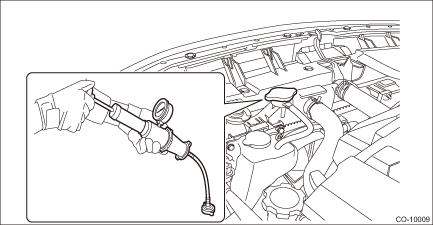
1. Check that the radiator does not have deformation, cracks or damage. 2. Check that the hose has no cracks, damage or loose part. 3. Remove the radiator cap, fill the radiator with engine coolant, and then install the radiator cap tester to the filler neck of radiator.
4. Apply a pressure of 157 kPa (1.6 kg/cm2, 23 psi) to the radiator and check the following points: • Leakage from the radiator or its vicinity • Leakage from the hose or its connections CAUTION: • Engine should be turned off. • Clean the check points. • Be careful not to deform the filler neck of radiator when installing and removing the radiator cap tester. • Be careful of engine coolant from spurting out when removing the radiator cap tester. |
 Removal
CAUTION:The radiator is pressurized when the engine and radiator are hot. Wait until engine and radiator cool down before working on the radiator.1. Remove the collector cover.(1) Carefully pull up th ...
 Installation
1. Install the radiator lower cushion to the vehicle body.2. Install the radiator to vehicle.NOTE:Make pins on the lower side of radiator be fitted into the radiator lower cushions.3. Remove the ropes ...
Other materials:
Headlights
To turn on the headlights, turn the knob on
the end of the turn signal lever.
" " position:
The headlights are all off.
" " position:
Instrument panel illumination, headlights,
parking lights, front side marker lights, rear
side marker lights, tail lights and license
plate lights are o ...
